
March 2026 BAHREC Newsletter 
BAHREC | Message from Leadership

Brad Margolis, President, 2026-2027
Hello BAHREC Members,
Spring is arriving, and with it comes a sense of transition. In many ways, that feeling mirrors what we're experiencing in our professional lives. The landscape around us continues to shift, and as senior HR leaders, we find ourselves at the center of helping our organizations and our people make sense of it all.
The past few months have brought policy changes, economic signals, and societal conversations that are landing directly on our desks. Some create immediate operational questions. Others surface deeper concerns among our employees about stability, belonging, and the future. Regardless of where any of us stand personally, our role remains the same: to lead with clarity, empathy, and steady judgment.
What I've observed in conversations with many of you is that the questions we're fielding have grown more complex. Employees are looking to us not just for answers, but for reassurance. Leaders are seeking guidance on how to communicate through ambiguity. And we ourselves are working to stay informed, adaptable, and grounded while the ground keeps moving.
This is precisely why our community matters. BAHREC exists so that none of us has to navigate these challenges alone. The collective experience in this community is remarkable, and there is real power in being able to share what we're seeing, test our thinking, and learn from peers who understand the weight of this work.
You may be hearing from us soon. Over the coming weeks, board members will be reaching out personally to connect with our members. We are rethinking how BAHREC can provide the most value, and we genuinely want your input. These conversations will be brief and informal, but your perspective will directly shape the direction of our network. I hope you'll take a few minutes to share what matters most to you.
We're also planning a collaborative working session this spring where members will help shape the future of BAHREC for our community. More details to come.
Thank you for being part of this community. Your leadership matters, and so does your wellbeing.
Brad Margolis
President, BAHREC
Monthly Program & Networking Event
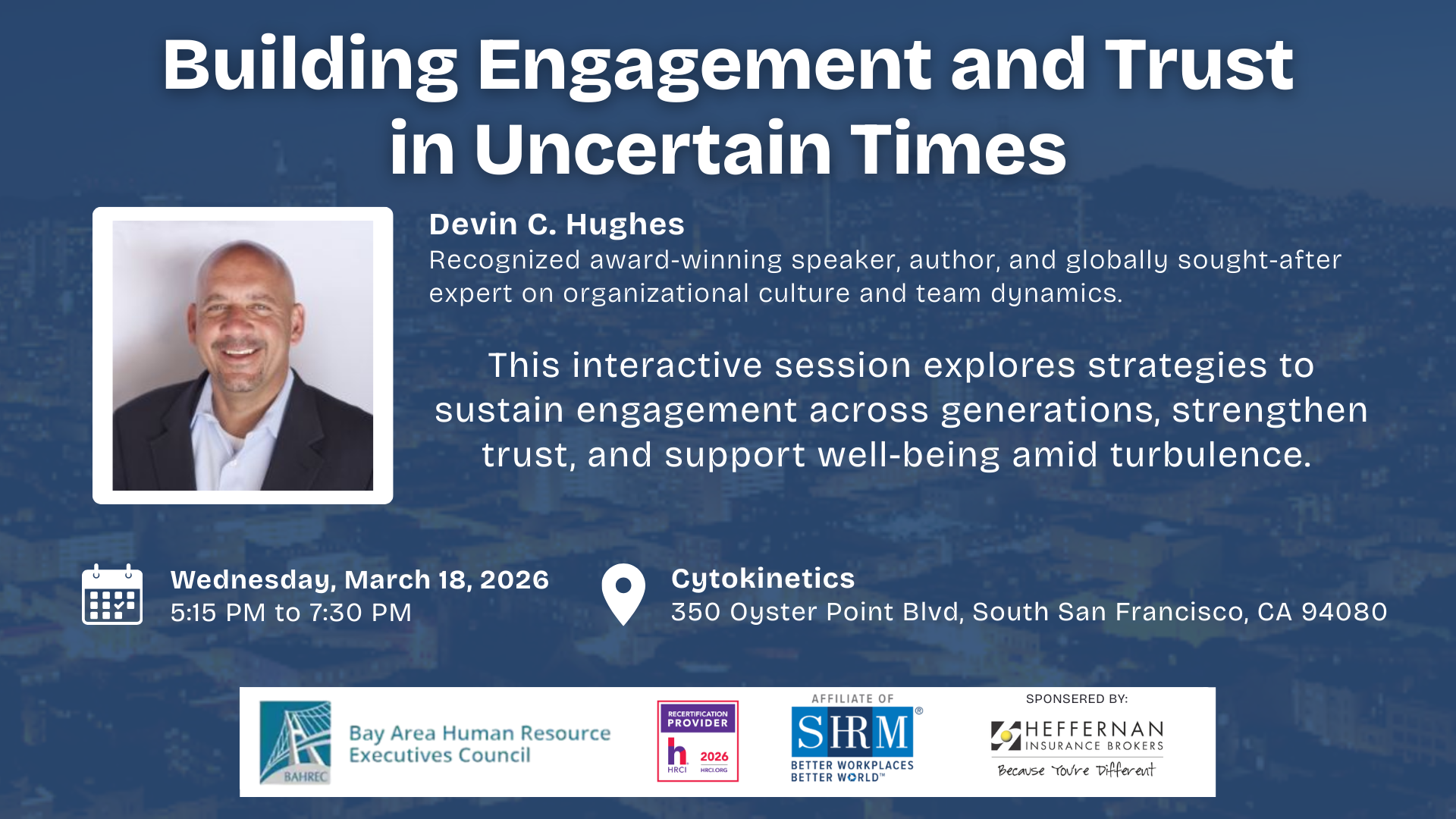
Building Engagement and Trust in uncertain times
Date: Wednesday, March 18, 2026
Time: 5:15 PM - 7:30 PM
Location: 350 Oyster Point Blvd, South San Francisco, CA 94080
BAHREC Members, click this link to register today for the Early Bird discount!
Helping HR leaders foster stability, engagement, and well-being when the future feels unclear.
In a workplace shaped by constant change, from shifting business priorities to global uncertainty, HR leaders play a critical role in helping employees feel grounded and connected. This interactive session explores strategies to sustain engagement, strengthen trust, and support well-being amid turbulence.
Devin Hughes: An award-winning speaker, author, and globally sought-after expert on organizational culture and team dynamics, Devin helps leaders and teams do more than check the box on engagement—he shows them how to light it on fire (in the good way). He’s got a sixth sense for sniffing out stale workplaces and helping turn them into thriving, connected ecosystems where people actually want to show up.
Forget the corporate fluff—Devin brings real talk, bold ideas, and a human-first approach that sticks. With a rare mix of insight, storytelling, and just the right dose of sarcasm, he tackles big topics like civility, belonging, and communication without making anyone want to check their inbox mid-session. Named one of PeopleHum’s Top 200 Thought Leaders to Watch in 2024, Devin holds a BA from Colgate University and an MS from Southern New Hampshire University. His work spans Fortune 100 giants, scrappy startups, and mission-driven organizations that want more than just another PowerPoint parade. He doesn't just talk about better workplaces—he helps build them.
Learning Objectives:
- Understand how uncertainty affects motivation, trust, and engagement across different generations.
- Learn evidence-based communication practices to build psychological safety and resilience
- Create an actionable plan for reinforcing well-being and belonging during organizational change.
Check out these links!
and
This program is APPROVED for 1.5 recertification credit hours for SHRM and HRCI.
This program is possible thanks to our returning Platinum Sponsor, Heffernan Insurance.
Insights From Our Latest Program
If you missed our recent Lunch & Learn on the neuroscience behind decision-making, it was one of the most practical sessions we’ve had this year.
This standout session highlighted how understanding our team’s risk tolerance, cognitive shortcuts, and decision framing can materially change outcomes. Many left with tools they can apply immediately to leadership, hiring, and prioritizing decisions.
If you couldn’t attend, you missed a good one — It was relevant and immediately usable.
We hope you can make it to our upcoming BAHREC event on March 18th!
Inclusive Leadership
A message from BAHREC VP of Diversity, Equity, and Inclusion, Porsche C. Williams:

The 2025 Women in the Workplace report arrives at a critical inflection point. After years of hard-won progress, organizational commitment to women’s advancement is rapidly eroding, and the consequences will be felt for years to come. For over a decade, McKinsey and LeanIn.Org have interviewed and surveyed HR leaders and employees to provide companies with important insights and tools about burnout, sponsorship, and roadblocks to progress in order to advance women in the workplace. Here are a few key takeaways:
-
Top Wins: Companies that performed in the top-quartile accelerated their representation gains between 2021 and 2025, demonstrating that organizational behavior has a direct impact on financial outcomes. Over 85% of employees across all levels agree that workplaces should be fair, inclusive, and encourage diverse perspectives. When employees experience fair and inclusive workplaces, they are 2x more likely to feel motivated, comfortable taking risks, and empowered to speak up.
-
Where Gaps Persist: The most significant barrier to gender parity is not the glass ceiling, it is the “first rung.” For the eleventh consecutive year, women are underrepresented in the critical manager promotion. For every 100 men promoted to manager, only 93 women make the same step forward. For Black women the number drops to 60, and for Asian and Latinas, it is 82. Why does this matter? For every woman who doesn’t make it to manager represents a permanent reduction in the pipeline for VP, SVP, and C-suite representation. Fixing the broken rung is the highest-leverage intervention available. Audit promotion rates from entry to manager, implement clear criteria for promotion decisions and require bias-awareness training before evaluation cycles.
-
Sponsorship: Active advocacy for advancement is among the most powerful career accelerants in the data. Yet, women are systematically undersponsored. 50% of women have sponsors, versus 56% of men, and the gap compounds over careers. At the entry level, only 31% of women have a sponsor versus 45% of men. Sponsorship in most organizations is informal, proximity-dependent, and inherently biased toward those with the most visibility. To close this structural gap, organizations need formal sponsorship programs. Assign senior sponsors to entry-level women, and track and report sponsorship and promotion outcomes annually.
-
Flexibility Stigma: Remote work has created an unexpected penalty for women that does not apply to men. Women working remotely 3 + days per week have a sponsorship rate of 37%, versus 54% for on-site women. Remote women’s promotion rate is 37% versus 53% for on-site women. Men’s sponsorship and promotion rates are similar regardless of where they work. This is evidence that proximity bias and informal sponsorship norms punish women who use flexibility. Organizations must explicitly address how visibility and advocacy operate in hybrid environments. Train leaders on proximity bias, and establish that remote and hybrid employees are evaluated by outcomes, not visibility. Monitor promotion rates by work location and intervene where gaps appear.
-
Structural vs Individual Persistence: The 2025 report introduces a concerning ambition gap indicating that 80% of women want promotions versus 86% of men. At the same time, the report shows that when women receive the same career support as men, the gap disappears entirely. So is it that women are less ambitious or less supported? For example, flexible work, which is a proxy for caregiving access, has been reduced at 25% of companies and this reduction disproportionately impacts women. High-performing companies link executive accountability to D&I outcomes. It is a choice. Organizations that treat gender diversity as a genuine priority with clear accountability, structured programs, and disaggregated measurement are outpacing those that don’t.
The Importance of Addressing the Gender Leadership Gap in Life Sciences
Article by Rosie Barden, Meet Life Sciences

Despite women being strongly represented at early and mid-career levels in life sciences, we continue to witness a tremendous gender imbalance in top positions. Women today make up 48% of the entry-level workforce, but as the ranks rise, this figure steadily declines. At the C-suite and executive level, women make up just 29% of roles.
What’s worse is that, according to the 2025 Global Gender Gap Report, it will take 123 years for this gap to close. This statistic highlights the persistence of barriers and biases – and how something must be done to achieve parity sooner.
Meet Life Sciences collected data from more than 25,000 life sciences professionals to gather views, insights, and lived experiences of the gender leadership gap. We wanted to hear about the challenges and attitudes first-hand, as we know for a fact that there is no shortage of qualified, ambitious women in the industry.
Our survey found mixed results. Only 60% of respondents believed their organization had equal opportunities and access to top roles, and more than half (56%) believed that men were at an advantage for career development opportunities. While 92% answered that they would like to see more women in leadership, that still leaves 8% actively resisting positive change.
The gap between where we are and where we need to be is still too wide. Representation cannot stop at visibility; it must extend to parity, pay equity, and equal access to progression. After all, women are not asking for special treatment. They only want to be treated fairly.
Our white paper examines why the gender leadership gap persists and how organizations can begin to make crucial changes. After all, the gap doesn’t just harm women; it weakens innovations, limits growth, and holds back the life sciences sector as a whole.
The report also includes a complimentary guide on how your organization can rewrite the rules of leadership access for women. With five key steps, our guide aims to prompt teams to go beyond awareness and start taking actions that can close the gender leadership gap. This includes designing hiring methods that reduce bias, making internal progression possible and more visible, and creating a culture where women want to stay and thrive.
To read the report in full, which has been mentioned in both Fierce Pharma and Fierce Biotech, you can download your copy here.
Cultural Observances: February 2026
3/8: International Women’s Day
3/20: Ramadan Ends
3/21: World Down Syndrome Day
3/25: International Day of Remembrance of the Victims of Slavery and the Transatlantic Slave Trade
3/29: Palm Sunday
3/31: International Transgender Day of Visibility
Member Spotlight

Mahi Saraf, People and Culture Leader and VP, Communications, BAHREC
Being a member of BAHREC and serving on the board is deeply fulfilling. It’s a powerful community of HR leaders who don’t just share and collaborate but also actively challenge one another to navigate uncertainty and shape engaging, inclusive, and trust-centered workplaces. I value the opportunity to learn from diverse experts and grow alongside inspiring peers, and I look forward to continuing to contribute and evolve with this incredible community.
~ Mahi Saraf
Welcome New Members
Please welcome our Newest Members:
Peggy Bridgford, Chief HR Officer, Fractional CHRO of Silicon Valley
Karen Neuendorff, Chief People Officer, Brii Biosciences
Share Opportunities with the BAHREC Network
The BAHREC Jobs & Ads page is now online. Please share opportunities and let the power of the network support your organization today.
